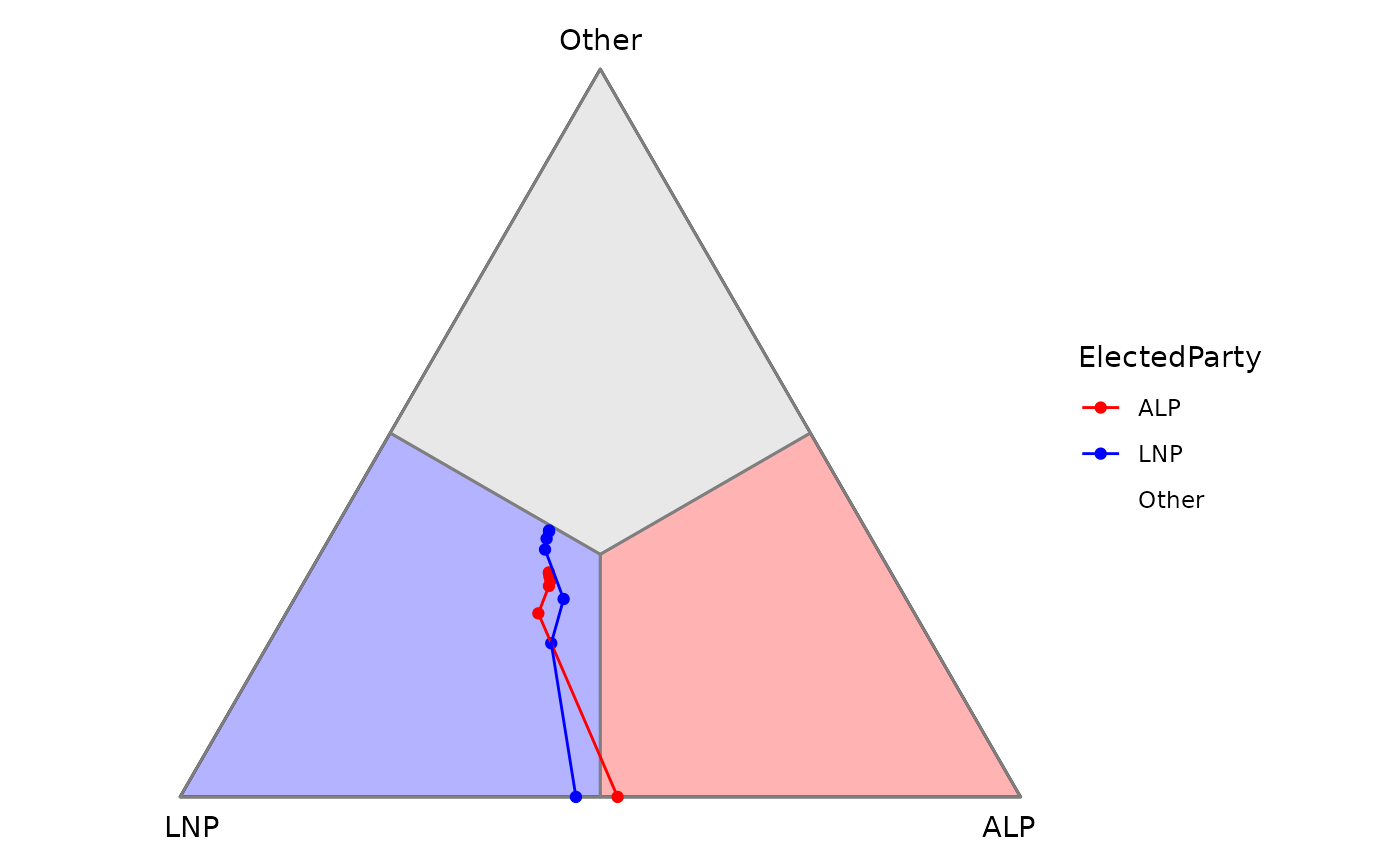
stat_ordered_path() reorders observations along each path using a user-supplied
ordering aesthetic (order_by) before drawing the path. The statistic can be
used to ensure that paths are drawn in a consistent order even when the input
data are not pre-sorted. This is equivalent to reordering the data before
passing it to geom_path().
Usage
stat_ordered_path(
  mapping = NULL,
  data = NULL,
  geom = "path",
  position = "identity",
  show.legend = NA,
  inherit.aes = TRUE,
  decreasing = TRUE,
  na_method = c("drop_na", "drop_group"),
  ...
)

StatOrderedPathArguments
- mapping
Set of aesthetic mappings created by
ggplot2::aes(). Must at least supplyx,y, andorder_by. Thegroupaesthetic can be used to define separate paths.- data
Data frame to be used for this layer. If
NULL, the default, the data is inherited from the plot.- geom
The geometric object to use to draw the paths. Defaults to
"path".- position
A position adjustment to use on the data for this layer. This can be used in various ways, including to prevent overplotting and improving the display. The
positionargument accepts the following:The result of calling a position function, such as
position_jitter(). This method allows for passing extra arguments to the position.A string naming the position adjustment. To give the position as a string, strip the function name of the
position_prefix. For example, to useposition_jitter(), give the position as"jitter".For more information and other ways to specify the position, see the layer position documentation.
- show.legend
Logical or
NA. Should this layer be included in the legends?NA, the default, includes the layer if any aesthetics are mapped.- inherit.aes
If
FALSE, overrides the default aesthetics, rather than combining with them.- decreasing
Logical. If
TRUE, paths are ordered in decreasing order oforder_by. IfFALSE(default), ordering is increasing.- na_method
Character string specifying how to handle missing values in
order_by. One of:"drop_na"(default): drop only rows whereorder_byisNA;"drop_group": drop entire groups that contain anyNAinorder_by.
- ...
Additional parameters passed on to the underlying geom.
Details
The statistic expects an order_by aesthetic that supplies the variable used
to order observations within each group.
Missing values order_by are handled according to na_method.
If na_method is "drop_na", missing values are dropped from the data, and the path is
still drawn, but might skipping steps due to missing values. If na_method is "drop_group",
the entire group whose missing values belong is dropped from the data, and the path is not drawn.
Ties in order_by are allowed but trigger a warning and preserve the original
row order for tied values.
Duplicates in order_by are dropped and a warning is issued.
Grouping is controlled via the usual group aesthetic. If a group column
is present in the data, reordering is performed independently within each
group; otherwise, the entire data is treated as a single path.
Aesthetics
stat_ordered_path() understands the following aesthetics (required are in
bold).
x
y
order_by
group
alpha, colour, linewidth, linetype, etc. (inherited from
ggplot2::geom_path())
Examples
library(ggplot2)
library(dplyr)
# Data prep
input_df <- prefviz::aecdop22_transformed |>
   filter(DivisionNm %in% c("Higgins", "Monash"))
tern22 <- as_ternable(input_df, ALP:Other)

# Base plot
p <- get_tern_data2d(tern22) |>
  ggplot(aes(x = x1, y = x2)) +
  add_ternary_base() +
  geom_ternary_region(
    aes(fill = after_stat(vertex_labels)),
    vertex_labels = tern22$vertex_labels,
    alpha = 0.3, color = "grey50",
    show.legend = FALSE
  ) +
  geom_point(aes(color = ElectedParty)) +
  add_vertex_labels(tern22$simplex_vertices) +
  scale_color_manual(
    values = c("ALP" = "red", "LNP" = "blue", "Other" = "grey70"),
    aesthetics = c("fill", "colour")
  )

# Add ordered paths
p +
  stat_ordered_path(
    aes(group = DivisionNm, order_by = CountNumber, color = ElectedParty))